The Dropping Dictionary
A dropping set collects every integer whose orbit first falls below its start after the same number of steps. The sets themselves are disjoint, but their destinations overlap, and you can run them backwards — from a destination value, reconstruct the numbers that drop onto it. This page is about the rules for doing that. They turn out to be a single dictionary, read in two opposite directions; and no finite machine translates between the two directions, for a reason that goes back to a 1969 theorem about bases 2 and 3. The objects here are classical, nothing is claimed as new, and none of it bears on the conjecture: the last section says why.
This is the companion to The Wobble: that page dissected the perturbation on a single orbit; this one is about the combinatorics of one dropping round and how the and structures interlock.
One round is an affine map
By the Affine Orbit Structure theorem, the integers sharing one parity word over a dropping round of length form a class on which the destination map is exactly affine. Each class is pinned by a triple , with its number of odd steps, and carries
The collection of these triples is the dictionary. The whole story is that it is one table read two ways.
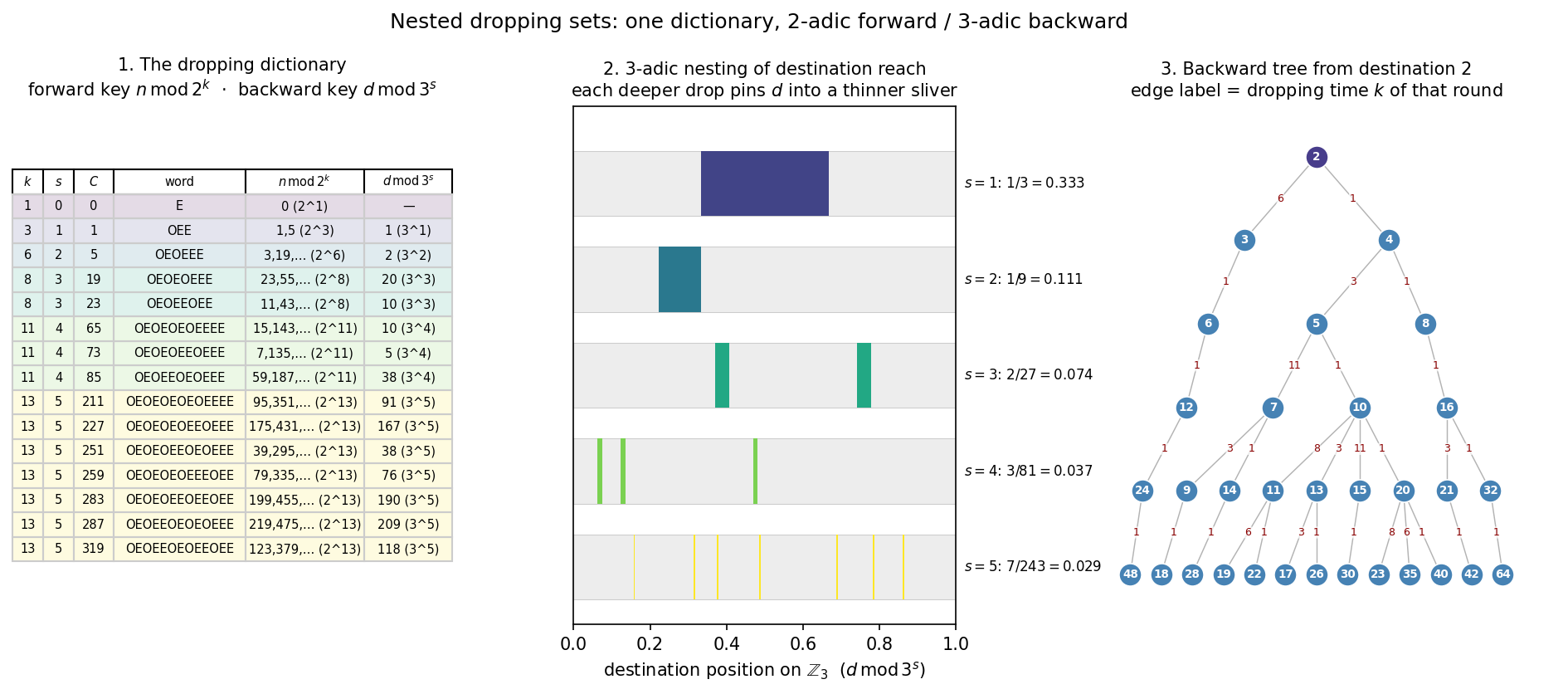
Forward you key on : the low bits pick the word, the word gives the destination. Pure 2-adic.
Backward you key on : a destination has a candidate predecessor in class iff , and then the candidate is unique:
The candidate follows the class's parity word, and it is a true predecessor exactly when it is larger than . At the class offers , which is not; any other failure would be a counterexample to Terras's coefficient stopping time conjecture (see the definitions), and there is none with (computed).
So "build a dropping set from its destination" is a literal lookup keyed by . The same table — 2-adic key going forward, 3-adic key going backward. That asymmetry is concrete: the forward map reads modulo a power of 2, its inverse reads modulo a power of 3. Keying predecessors modulo is standard (Lagarias 1985; Wirsching 1998).
The thinning is the 3-adic part. Each class maps its whole -residue class onto a single residue mod of the destination line, so as climbs, the destinations a depth- drop can reach are pinned into an exponentially thinner sliver — of the residues. The levels do not nest (level 1 reaches , level 2 reaches ); their reaches thin out, and they overlap in the sense that one value (e.g. ) is reached from several levels at once.
The alphabet is a ballot language
Strip a letter to its parity word. Apart from the one-letter word E (the even numbers, level ), a word is admissible iff it (1) starts with O, (2) has no two adjacent Os — because is always even, every odd step forces a following halving — and (3) is ballot-admissible: at every interior step, with the first drop only at the end. The only arithmetic input is the comparison ; no prime is privileged. Arithmetic (the 2) and multiplicity (the 3) are two readings of one lattice path.
The number of letters with odd steps, for , is
— from on this is OEIS A100982, which begins : the admissible Collatz sequences of the stopping-time literature (Wagon 1985, Terras, Chamberland, Winkler, Roosendaal). The extra leading 1 is , the word E. The object we reached by working backwards is classical, and so is the backward reading of it (Lagarias 1985; Wirsching 1998). Its growth rate, which follows from the binomial bounds of Winkler (arXiv:2609.22303, 2026), is the binomial entropy
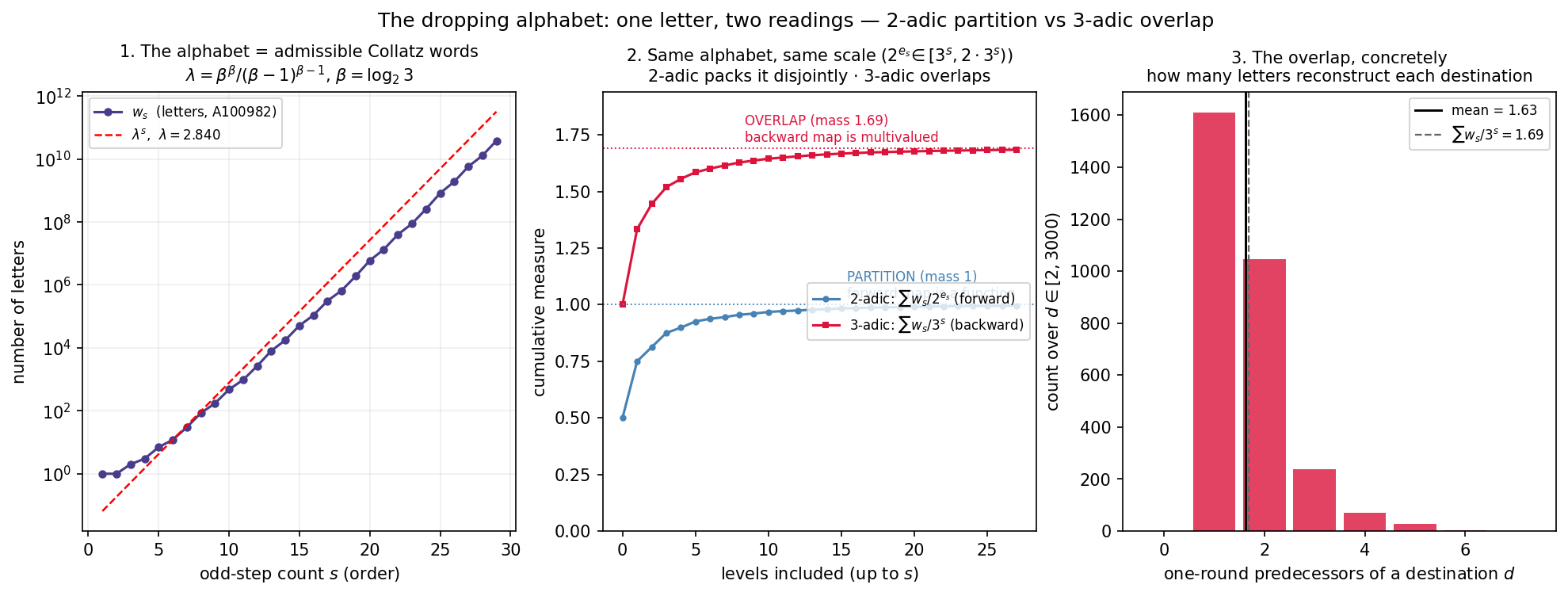
Now the asymmetry can be put in numbers. Each letter of level carries its two keys at the same scale, because the number of halvings in it is , which puts in :
| reading | key | total mass | meaning |
|---|---|---|---|
| Forward (2-adic) | the classes are disjoint and fill up to a set of measure zero (Terras 1976; the partial sum to is 0.99999997). An integer has at most one dropping word; that every integer above 1 drops at all is equivalent to the Collatz conjecture | ||
| Backward (3-adic) | (computed) | overlap — the map is multivalued; a destination has on average one-round predecessors (1.690 over , computed) |
The same alphabet, at the same resolution, tiles (up to a null set) under the 2-adic reading and covers 1.69 times over, on average, under the 3-adic reading. Forward, each has at most one image: disjoint preimages, total mass 1 by Terras's theorem. Backward, a has one source or several (exactly one when 3 divides ): overlapping images, mass 1.69. The excess over the trivial halving is the overlap of dropping orbits, quantified. (The predecessor histogram in the figure counts only letters of at most 22 steps, for , and has mean 1.63; with every letter the mean over that range is 1.689, computed.) Per level the reach is of the residues (all distinct for , computed), a share that shrinks roughly like , while the classes of the 2-adic reading leave out only a null set.
One continued fraction runs both sides
A letter is built from two blocks: (altitude step ) and (step ). Climbing one level adds one -block and either 0 or 1 -block, and that 0/1 schedule — the increments — is exactly the Beatty / Sturmian word of :
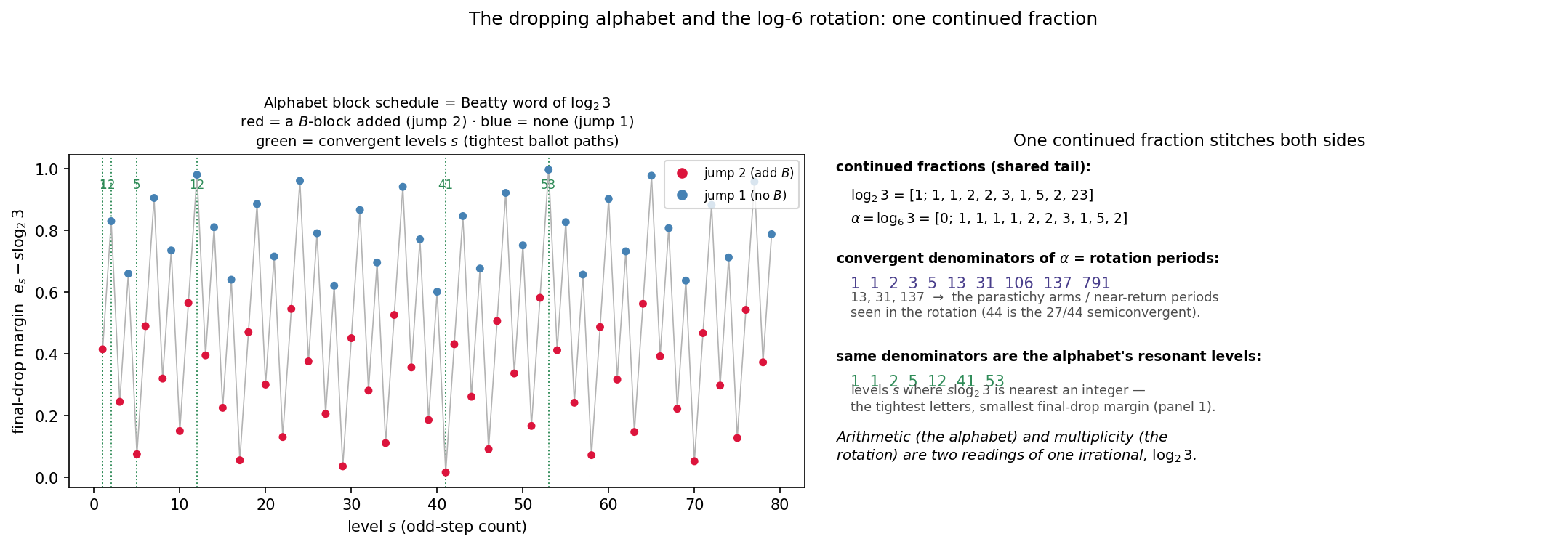
And is the same irrational that drives the log-6 rotation: with , the two share a continued-fraction tail, so the convergent denominators of ,
are the rotation's near-return periods — the parastichy arms, with 44 the semiconvergent. From 2 on, each is a sum over a convergent of : , , . The denominators are the levels of the alphabet at which is nearest an integer, and a letter of level is or steps long. The combinatorial alphabet and the harmonic rotation are two faces of one number.
No finite machine: Cobham's theorem
If that forward-to-backward correspondence were a single finite-state machine reading in base 2 and writing in base 3, we would have an explicit device converting arithmetic into multiplicity. It does not exist, and the reason turns out to have little to do with Collatz.
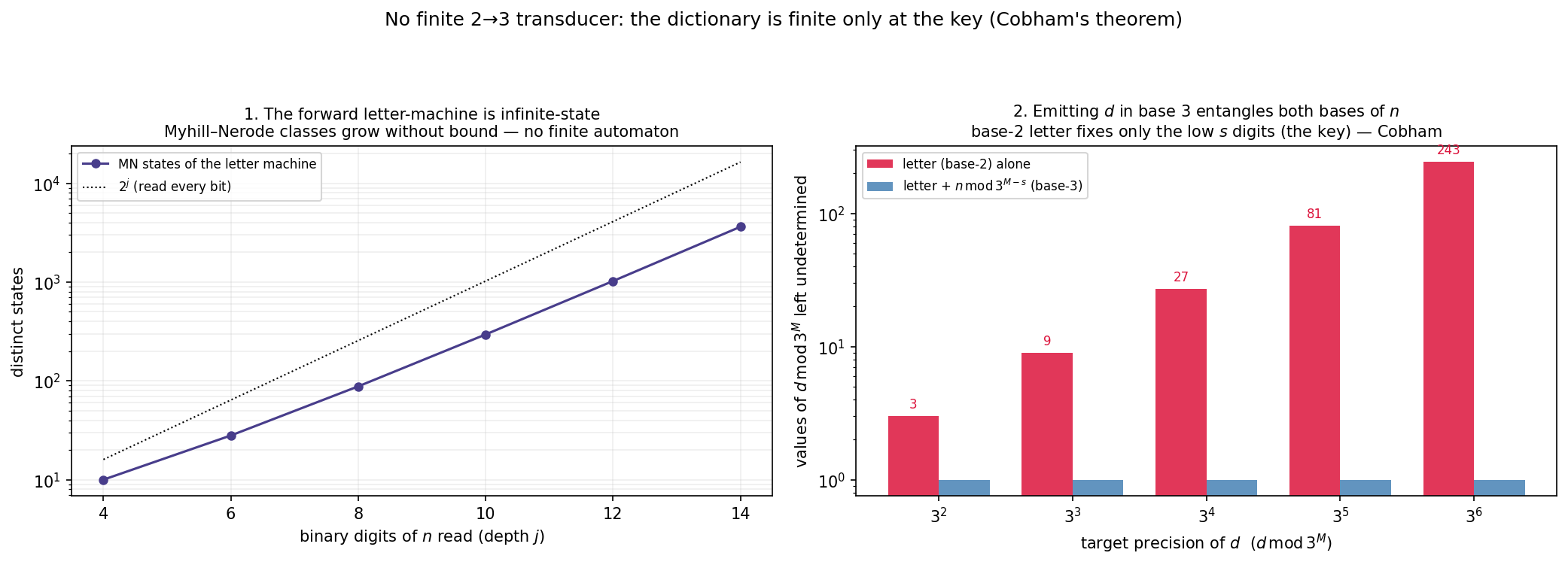
The forward machine is infinite-state. Reading LSB-first, the -th parity is — but the carry is the low-bit trajectory itself, an unbounded register: to go on writing parities, a machine must remember where steps of the shortcut map ( or ) have taken the bits read so far. The script counts such values at depths (computed), and the count cannot stay bounded, since alone goes to . No finite automaton writes the parity sequence, of which the letter is the opening stretch.
Emitting in base 3 entangles both bases of . Exactly, by one line of algebra (), and checked on 60,000 random odd below :
The letter needs base-2 digits of ; the remaining ternary digits of need , i.e. base-3 digits of . The letter alone leaves spread over up to values. So 's ternary expansion has a seam at digit : the low digits — the dictionary key — come from reading in base 2; every digit above comes from reading in base 3.
A finite base-2→base-3 transducer cannot exist, for a reason that has nothing to do with the seam. On even numbers the dropping map is , so such a machine would convert binary to ternary. Fed the powers of 2, a regular set of binary strings, it would have to produce a regular set of ternary strings (a finite transducer sends regular sets to regular sets): the expansions of the powers of 2. But by Cobham's theorem (1969) a set of integers recognisable by finite automata in two multiplicatively independent bases is ultimately periodic, and the powers of 2 are not. The same argument rules out a finite machine for the identity map: the obstruction is about bases 2 and 3, not about Collatz.
The dictionary works because it only ever matches the key: the low ternary digits, which the base-2 letter does determine. Push past the key and you must read modulo powers of 3.
What it means
The letter, read from the low binary digits of , fixes the low ternary digits of and nothing above them; and no finite machine converts between the two bases at all. The layers of this page, in order:
- the dictionary is finite per letter, never globally;
- the alphabet tiles up to a null set (Terras) but covers with overlaps;
- its length schedule is the Beatty word of ;
- and no finite machine joins the two readings, by a theorem about bases 2 and 3 that does not involve Collatz.
None of this bears on the conjecture. The alphabet, the two masses, the seam and the Cobham obstruction are the same for (its classes are the negatives of these), a map with cycles of its own, so nothing here can tell the two maps apart.
Where this lives in the repo
- Research note: Nested Dropping Sets (working notes)
- Scripts:
scripts/collatz_nested_dropping.py,collatz_dropping_alphabet.py,collatz_alphabet_rotation.py,collatz_dropping_transducer.py - Foundations: Affine Orbit Structure, The Hidden Rotation