The Wobble
The Hidden Rotation described a picture due to Shakibaei Asli (arXiv:2601.04289): in base-6 log coordinates, every Collatz step is the same rotation, , because . In the plain coordinate used here, that picture has exactly one imperfection — the "+1" in . This page takes that imperfection apart by computation, on the orbits named below. It is an exploration, not a step towards a proof: an odd step and a halving turn the circle by the same angle, so the rotation carries no information about size, and nothing here says whether an orbit falls. The same decomposition exists for , with the wobble negative, and that map has cycles of its own.
Writing , the orbit satisfies exactly
where the wobble collects one positive increment per odd step:
The wobble is the +1. Everything else is rigid rotation. Telescoping gives the exact identity for an orbit reaching 1 with halvings and odd steps: the wobble budget is the logarithm of the excess of halvings over triplings. The ratio is what Roosendaal tabulates as the residue of . Its largest value for below is 1.2531, at (computed), and he conjectures that no does better.
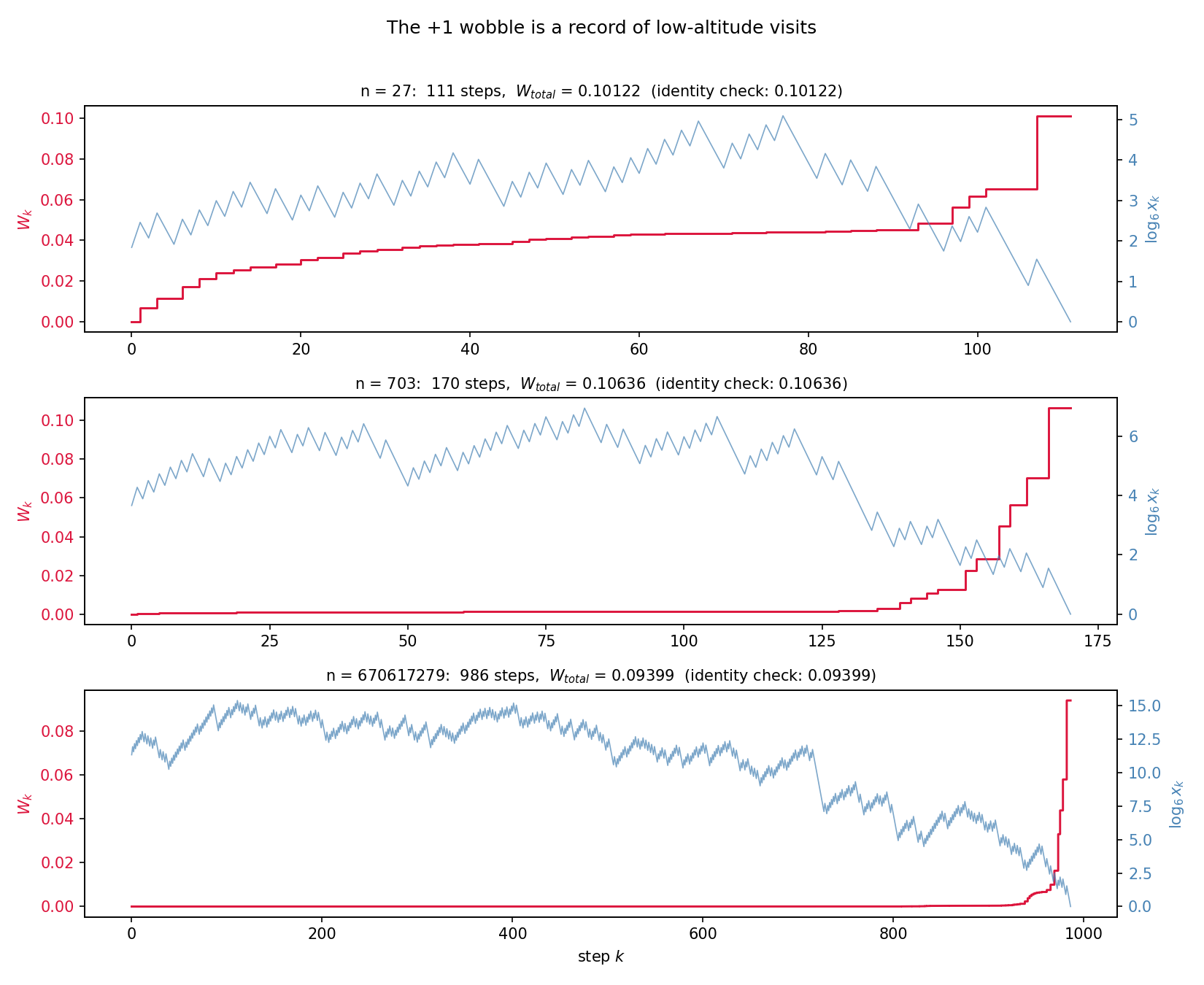
For the 987-point orbit of 670617279, 92% of the total wobble comes from odd values below 100. The wobble is a record of the orbit's visits to small numbers.
Carrier × envelope: when it ticks and how much
The wobble is a pulse train with two components:
- Envelope (how much): the increment is fully determined by position: where is the altitude. This is the definition rewritten (), so every orbit point lies on the one curve: the size of a tick depends only on where the orbit is.
- Carrier (when): the gaps between odd steps are . Computed on 16,704 gaps from 400 orbit windows with random odd seeds between and : the mean gap is 2.97 (independent geometric gaps would give 3), the correlation between successive gaps is (two standard errors: ), and the averaged periodogram matches a renewal null ( on 64 bins). At this resolution the timing looks like independent geometric gaps, the usual heuristic for the 3x+1 map, and no trace of the rotation was detected in it.
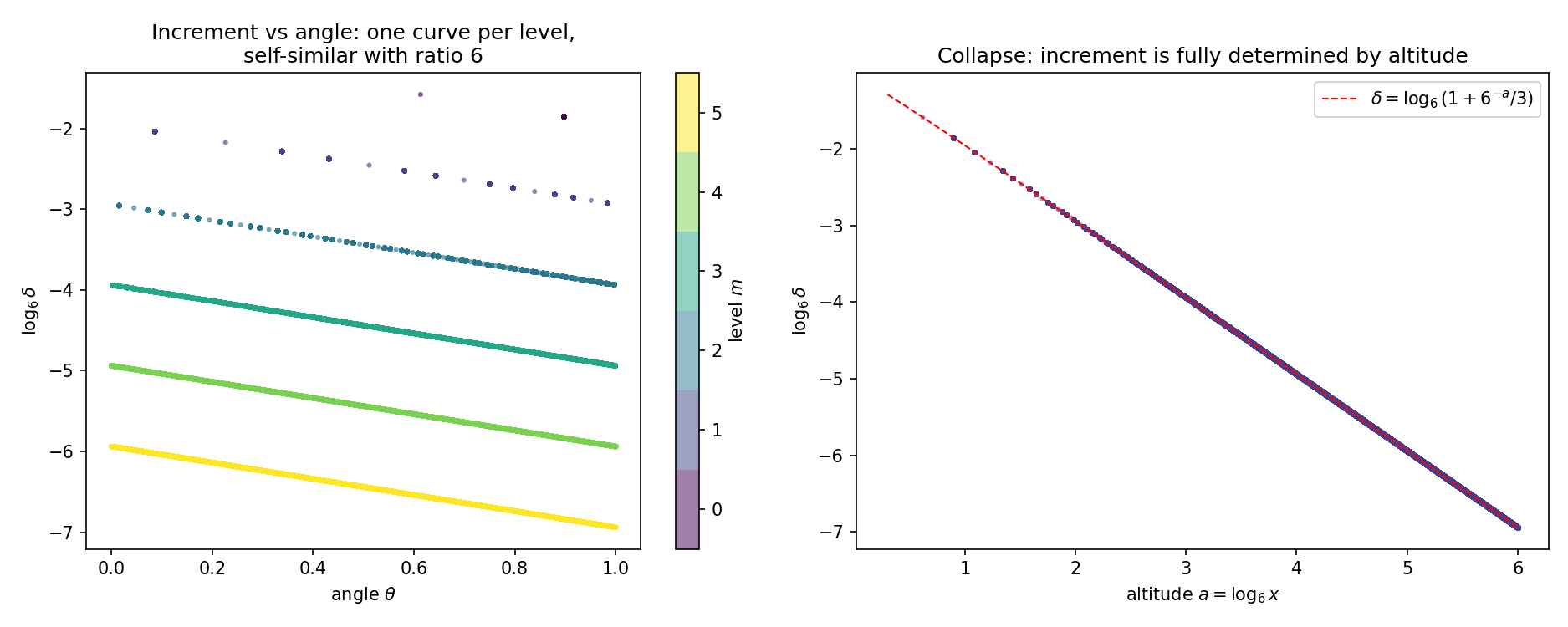
When the wobble ticks is read off the low binary digits of ; how much it ticks is read off the size of . That much is exact, from the two formulas. Whether the two are independent along an orbit is a statistical question, and this page has only null results to offer on it: the carrier test above, and a test further down of dropping time against gateway.
Coherence: the crystal analogy
Treat as phase disorder on the rotation. The coherence factor has the same form as the Debye–Waller factor, which gives the damping of the -th Bragg peak of a crystal when the disorder is independent of position. Here that is an analogy only: the wobble is not independent of position, it only grows.
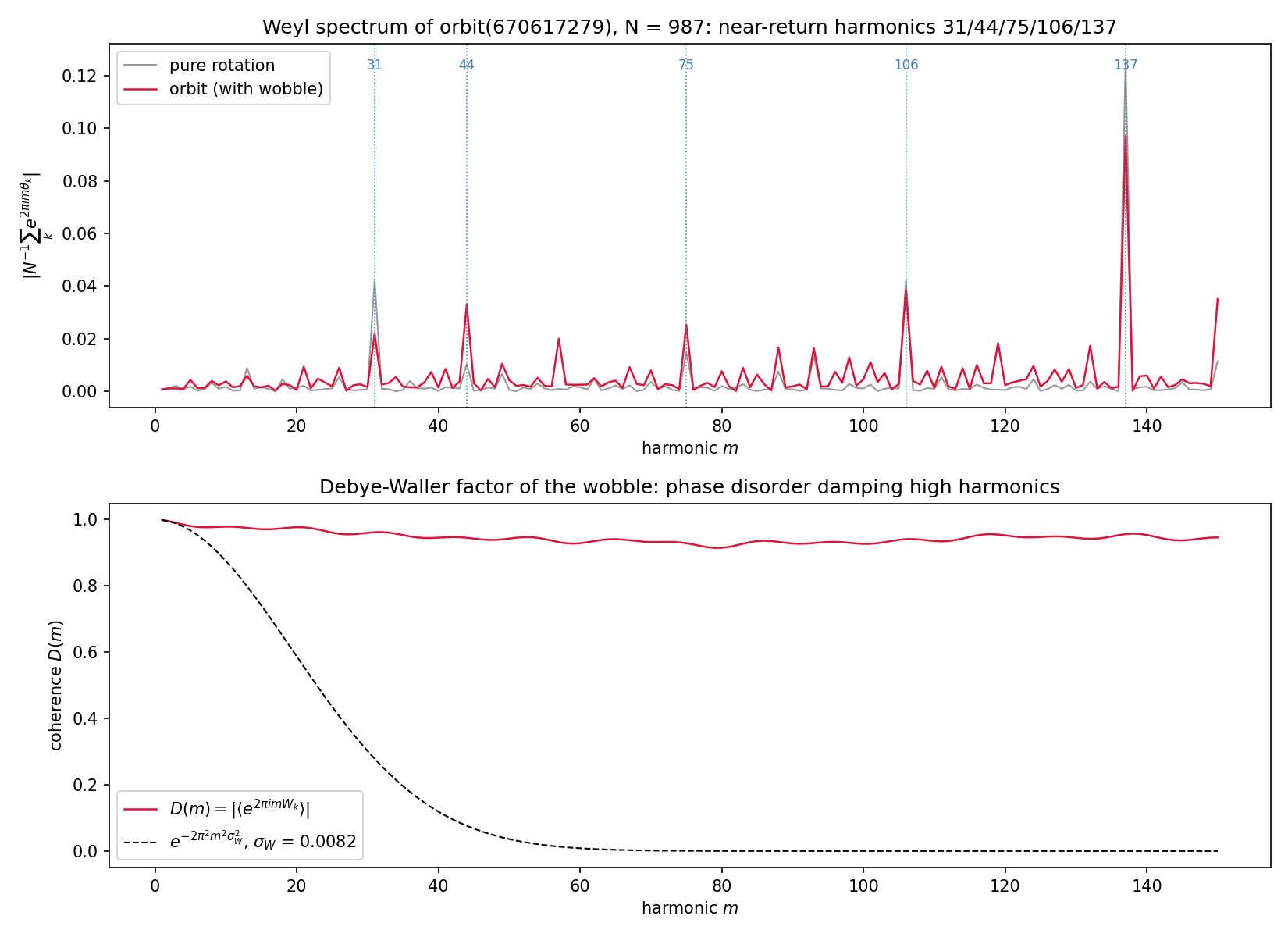
For the 987-point orbit of 670617279, . Gaussian phase noise of that size would halve the coherence by and destroy it by . Computed: out to . The reason is visible in the traces above: the wobble is long plateaus and a few late kicks, and 98% of this orbit's points come before a tenth of the wobble has accrued. does not give the height of the peaks, though: on the same orbit the 31-peak is half what the pure rotation gives and the 44-peak three times as much. That is the next section.
44 against 31: a one-sided lens
The peaks sit at the continued-fraction denominators of : 13, 31, 106, 137 are convergents; 44 = 31+13 is a semiconvergent. By pure Diophantine quality, 31 () beats 44 (). Yet in the Weyl spectrum of the orbit of 670617279 the 44-peak stands above the 31-peak (0.033 against 0.022), where the pure rotation has them the other way round (0.010 against 0.042). Why?
Because the wobble is always positive, it can only push a near-return one way: it cancels misses that close from below (: 13, 44, 75, 106) and worsens misses that close from above (: 31, 137). Over 8 long orbits and 37 near-return peaks (computed), the peaks came out enhanced in 75% of cases (median ratio 2.08) and the peaks damped in 62% (median ratio 0.94): a tendency, not a rule. On the orbit above, the peaks at 13 and 106 are damped although their is negative.
By the identity at the top of the page, the -step closure miss is exactly , with the wobble gained in those steps (as long as that sum stays below ; on the orbits used here it never exceeds 0.13). For the miss can never be less than . For it shrinks towards zero as approaches and grows again beyond. The wobble rate rises as the orbit comes down, so each closure comes nearest to cancelling at an altitude of its own. Binning the miss by , and by altitude, over 500 orbits (the first 500 odd seeds above whose orbits have at least 250 points):
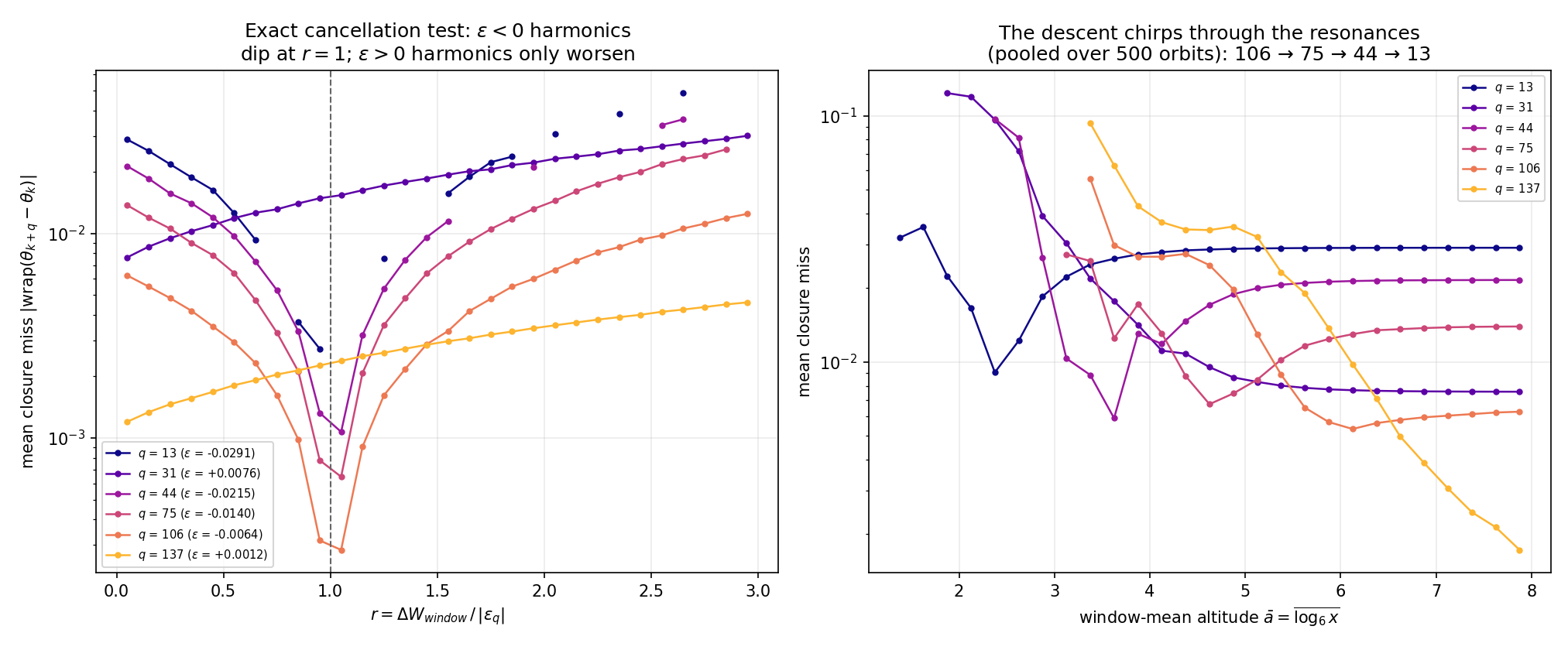
The dip at is that identity, not a measurement, and 31 and 137 can only climb. What is measured is where along the descent each harmonic meets it. In these 500 orbits the dips sit at window-mean altitudes of about 6.1 for 106, 4.6 for 75, 3.6 for 44 (values of several hundred) and 2.4 for 13. That suggests one more possible ingredient of the 44-cycles in the original Proportional Power Ratios article: the +1 nearly cancelling the 44-step miss low in the orbit. The 44 in the article's polar plots already has two plainer sources, given on the Prior Work page: the angle there is the step index in radians, and 44 radians is almost exactly 7 turns; and . Whether the cancellation adds anything visible to those plots has not been tested. The 31-step miss never falls below 0.0076, but averaged over the whole orbit of 670617279 it is still the smaller of the two (RMS 0.0116 against 0.0219 for 44).
The wobble budget is set near the bottom
looks like a per-orbit quantity, but in the range tested it is 99% a per-gateway quantity (computed): defining the landmark = first odd orbit value below 100, the 50 tail budgets explain 99.0% of the variance over all odd .
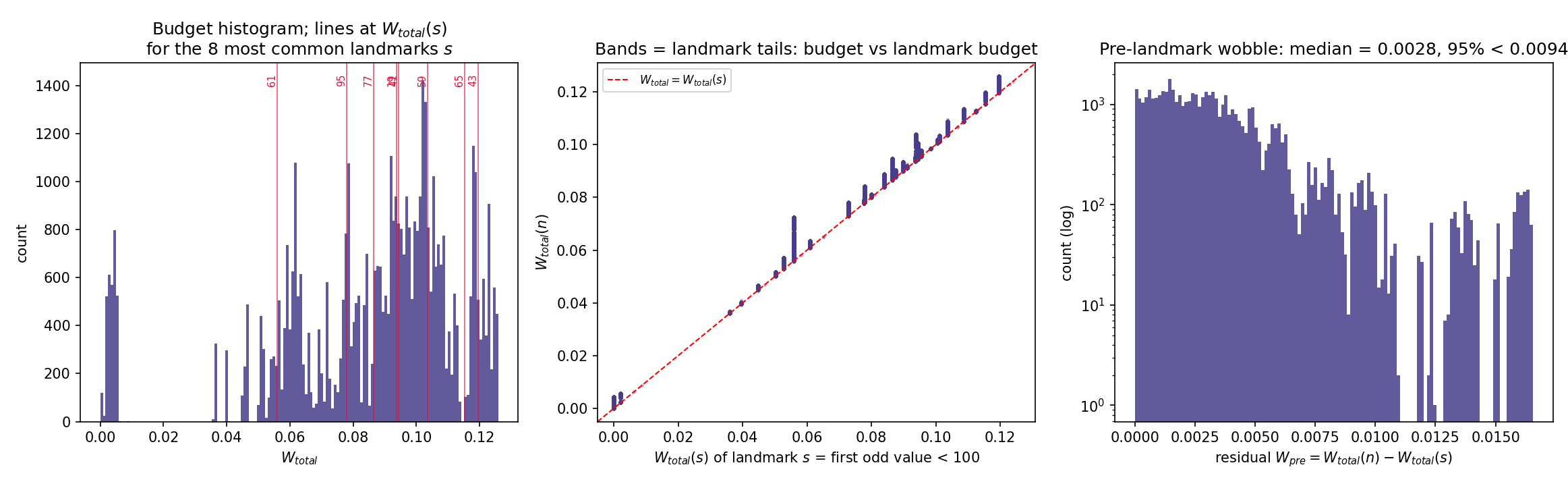
In the same range the gateway classification shows no relation to the dropping-time framework (computed, odd below ): inside residue classes mod , , the landmark fibers are about as pure as a shuffled null (excess at most 0.004); Cramér's V between landmark and dropping time is 0.049; their mutual information is within 1.2 standard deviations of the shuffled null. Dropping time is a head quantity, read from the low binary digits of . The gateway is a tail quantity, and no residue structure was found in it. These are null results at this sample size, not a proof of independence; and that every integer has a gateway at all is the Collatz conjecture.
The sunflower test: predicting 137
What the eye sees in a polar render of the orbit (angle , radius ) is a parastichy count — the same mathematics as the spiral arms of a sunflower head. Take the arm count at radius to be the index gap between a point and its nearest neighbour; for a rotation that is, to a good approximation,
which predicts: 13 arms inside , 31 arms to , then 137 arms — with 106 skipped entirely. Orbits that long typically need seeds around . A 145-digit seed gives a 3449-step orbit, and the observed arm count matches the prediction in all 12 radial bands:
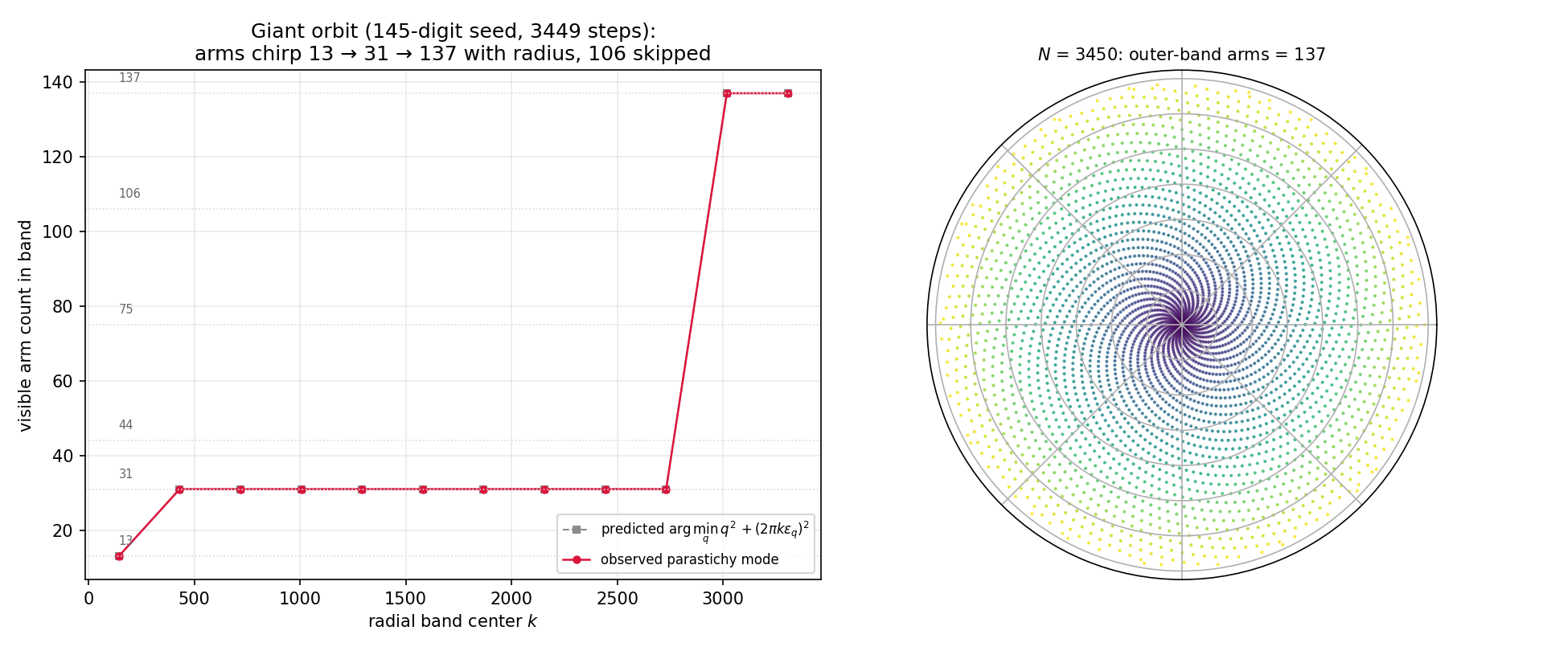
The prediction was made before the orbit was computed. It is a statement about the rotation number alone: a rigid rotation by with as many points shows the same twelve arm counts (computed). What the giant orbit adds is that the wobble is too small to disturb them.
A dictionary of physics analogies
| Collatz object | Physics counterpart |
|---|---|
| Rotation by | Integrable system; the unperturbed flow |
| Weyl peaks at 13/31/44/106/137 | Bragg diffraction of a 1D quasicrystal |
| Wobble | Disorder field / phase noise |
| Coherence | Debye–Waller factor (same formula; it does not give the peak heights here) |
| Odd-step train × increment law | AM signal: renewal carrier, deterministic envelope |
| Timing read from the low binary digits, amplitude from the size | Loosely adelic: one factor for each completion of , as in the Freund–Witten product formula of p-adic string theory |
| Near-cancellation at | Phase-locking of a driven oscillator; mode pulling |
| Arm counts 13 → 31 → 137 | Phyllotaxis / parastichy |
These are analogies, some closer than others: the Debye–Waller and parastichy rows share a formula with their counterpart, the rest only a resemblance. None is a claim of physical mechanism, and none is evidence about the conjecture.
Where this lives in the repo
- Research note: Log-6 Rotation Duality (working notes)
- Scripts:
scripts/collatz_log6_wobble*.py(six passes: dynamics, mechanism, bands, plateaus, cutoff, resonances) - The same quantity elsewhere on the site: the in the bookkeeping identity on The Hidden Rotation is