Thirty-Six
Four classical facts about one number. Thirty-six is triangular and square at once, . It is the sum of the first three cubes, . It is the least for which has exactly eight solutions, being Euler's totient. And is half the golden ratio. The Collatz map is made of the primes 2 and 3, and is their squares multiplied. So: do any of the four facts say something about Collatz orbits?
A research run in October 2026 took the question apart in five threads, one per fact and one more on triangle, square and cube together. Each thread then got a second, adversarial pass with its own code: the claims re-derived or recomputed (each thread file lists the few that were not), the same statement run for and , prior art searched. The answer is half a yes. Every fact does land on one object, the lattice of numbers on which a Collatz parity word is a path. But the four facts land at three different addresses, and 36 itself is almost never what does the work: the work is done by the pair , by the exponent point , and by the modulus . None of it is progress on the Collatz conjecture. Every Collatz-facing statement below either holds equally for , a map with cycles of its own, or depends only on residues.
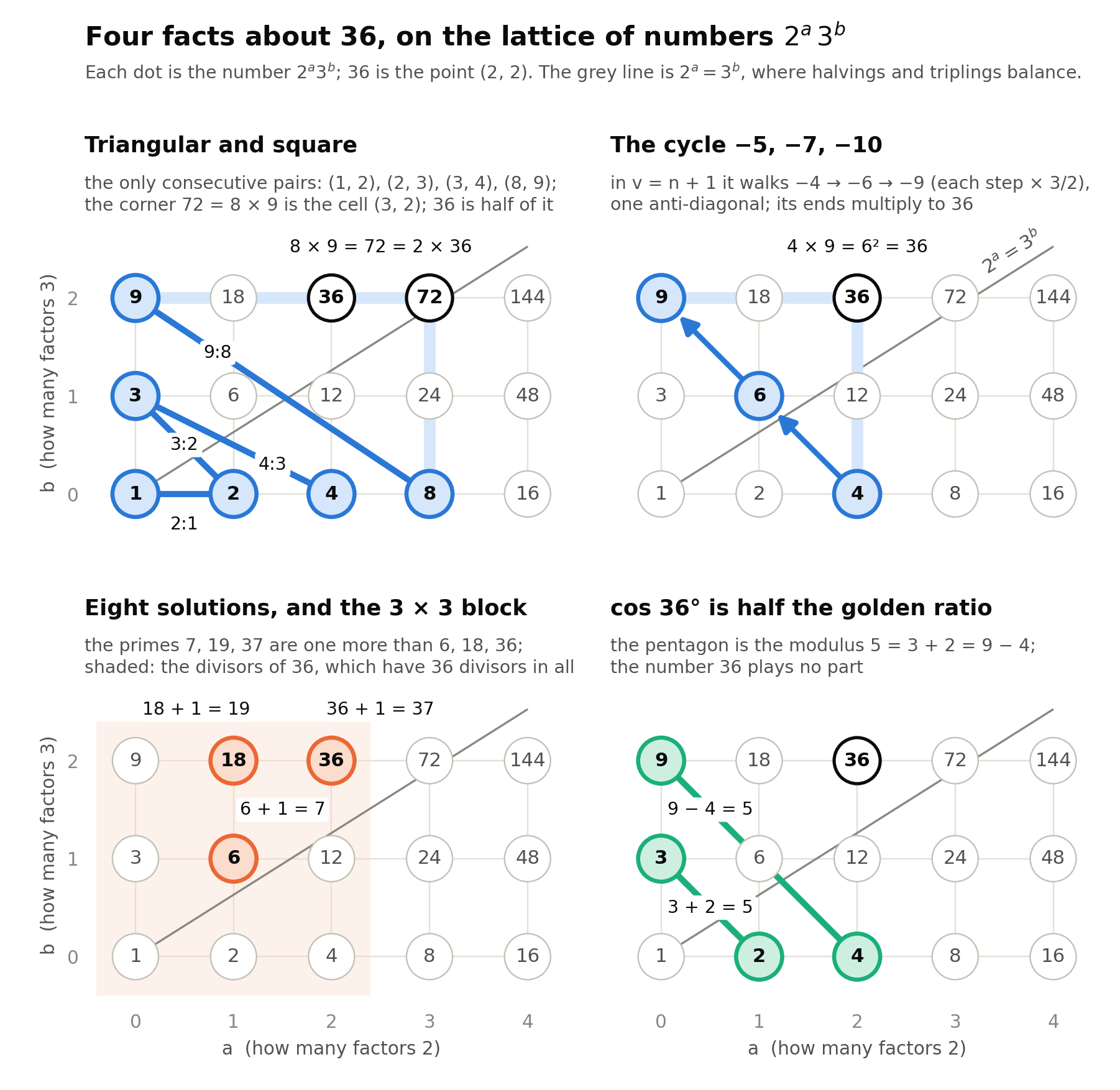
In the figure: top row, the first fact; bottom left, the point of the second and third; bottom right, the fourth.
Four facts, three addresses
, with brackets, is the shortcut map, for even and for odd ; , with a subscript, is the triangular number . The parity word of lists its steps, 1 for odd and 0 for even. Every step halves and an odd step also triples, so a word of letters, of them 1, is a path to the lattice point , the number ; that point, with its words, is the cell . The one number a word carries back to itself is a fraction with an integer (classical: Böhm and Sontacchi 1978, Lagarias 1990), so in a cell where every word closes on an integer for free. One such cell is : the point , next to 36, and is half of it.
| Fact | Where it lives | What does the work |
|---|---|---|
| triangular and square | the cell | the pair : |
| sum of the first three cubes | the exponent point | the shape , and |
| eight solutions of | the exponent point | the primes 7, 19, 37 at the points , , |
| is half the golden ratio | the modulus 5 |
Triangular and square: the last harmonic pair
The composer Philippe de Vitry asked which harmonic numbers, the numbers of medieval music theory, differ by one. Levi ben Gerson answered in 1343: only , , and . To a musician those are the octave, the fifth, the fourth and the whole tone, and there the list stops. Thirty-six is the triangular number of the last pair, , and since is built from 2s and 3s only when and both are, the list of such triangular numbers is exactly as short: 1, 3, 6, 36 (proved; a corollary of Levi's theorem).
| Pair | Interval | Triangular number | Cell | Cycle of on the integers |
|---|---|---|---|---|
| octave 2:1 | 1 | |||
| fifth 3:2 | 3 | |||
| fourth 4:3 | 6 | |||
| whole tone 9:8 | 36 |
Each pair is a cell with , and the four cells hold exactly these four cycles, one each (proved, and known: Steiner 1977, Lagarias).
Theorem (one even element; proved, and not new). A cycle of on the integers with exactly one even element, parity word , exists if and only if and are consecutive, if and only if is a triangular number, if and only if . The three cycles are , and (the table's fourth, , has no even element). In the coordinate , where an odd step is just , the last one reads
This is the one place in the run where 36 appears in a Collatz statement with a mechanism, and the mechanism is . The cycle climbs one anti-diagonal of the lattice, , and the single even step carries back to because 9 and 8 are neighbours. Thirty-six is the product of the two ends: a by-product, never an input. The theorem is the case of a single even step () of the circuit equation of Davison (1976) and Steiner (1977), where their divisibility condition collapses to "divides 1". And it does not see the sign: for the same cell holds the cycle , with .
Why the multiplier 3. For an odd multiplier , the equation forces unless (proved, elementary; a special case of Catalan's problem). So 3 has four such cells, a multiplier other than 3 has two, and every other odd multiplier has one. Only 3 has a cell at , and that cell is .
The fifth cycle, and a law that is not one. The only other known cycle of on the integers runs through , in the cell , where is the apotome of Pythagorean tuning. Octave, fifth, fourth, whole tone, apotome: it is tempting to hear a law, and it is a tautology plus a size constraint. Every ratio with small has a classical name, and a cycle that is large compared with the is pushed toward the record cells, the best one-sided approximations of (Crandall 1978, Eliahou 1993), where all five known cycles sit. Of the 257 primitive cycles of the maps , , that meet , 21% sit there too, and about 60% of those matched in size to the and cycles (53 of 89); the five known cycles of all sit in record cells of (computed). The pattern tells apart neither the sign nor the multiplier.
Fold, collapse, rigid: how three shapes meet the dropping sets
A dropping set holds the integers whose orbit first falls below its start after exactly steps, counting and separately; the values of known to occur are 1, 3, 6, 8, 11, 13, ... The classes behind these sets are residue classes modulo powers of 2 (Terras 1976), so the way a family of numbers meets them is decided by the family modulo . Triangle, square and cube do three different things there, all classical and none involving a Collatz rule:
- Triangular numbers fold. hit every residue modulo exactly once, and glues to . (It is why triangular probing visits every slot of a hash table of size : Hopgood and Davenport 1972.)
- Cubes are rigid. On the odd residues modulo , cubing is a permutation that keeps every 2-adic distance: an isometry. (Even cubes stay even, in .)
- Squares collapse. Every odd square is , and the squares cover only a sixth of the 2-adic integers.
A fold or a rigid map cannot disturb proportions, so triangular numbers and cubes carry the natural law of the dropping sets exactly. Among the first triangular numbers, half lie in , a quarter in , a sixteenth in , a sixteenth in , and so on down the list of The Dropping Dictionary: the same shares as among all integers, exactly and not just on average. This is proved as a count of residues, and for actual dropping times in every class modulo or less (0 and 1, which never drop, excepted); in general it is Terras's coefficient stopping time conjecture. The residue statement holds for every rule, each with its own shares (for they begin 1/2, 1/8, 1/16), so it distinguishes nothing. Squares are another matter.
Theorem (squares see the sign; proved; elementary, no novelty claimed). Under every square greater than 1 lies in (the even squares) or in (the odd ones), and nowhere else. Under the odd squares spread over infinitely many dropping sets.
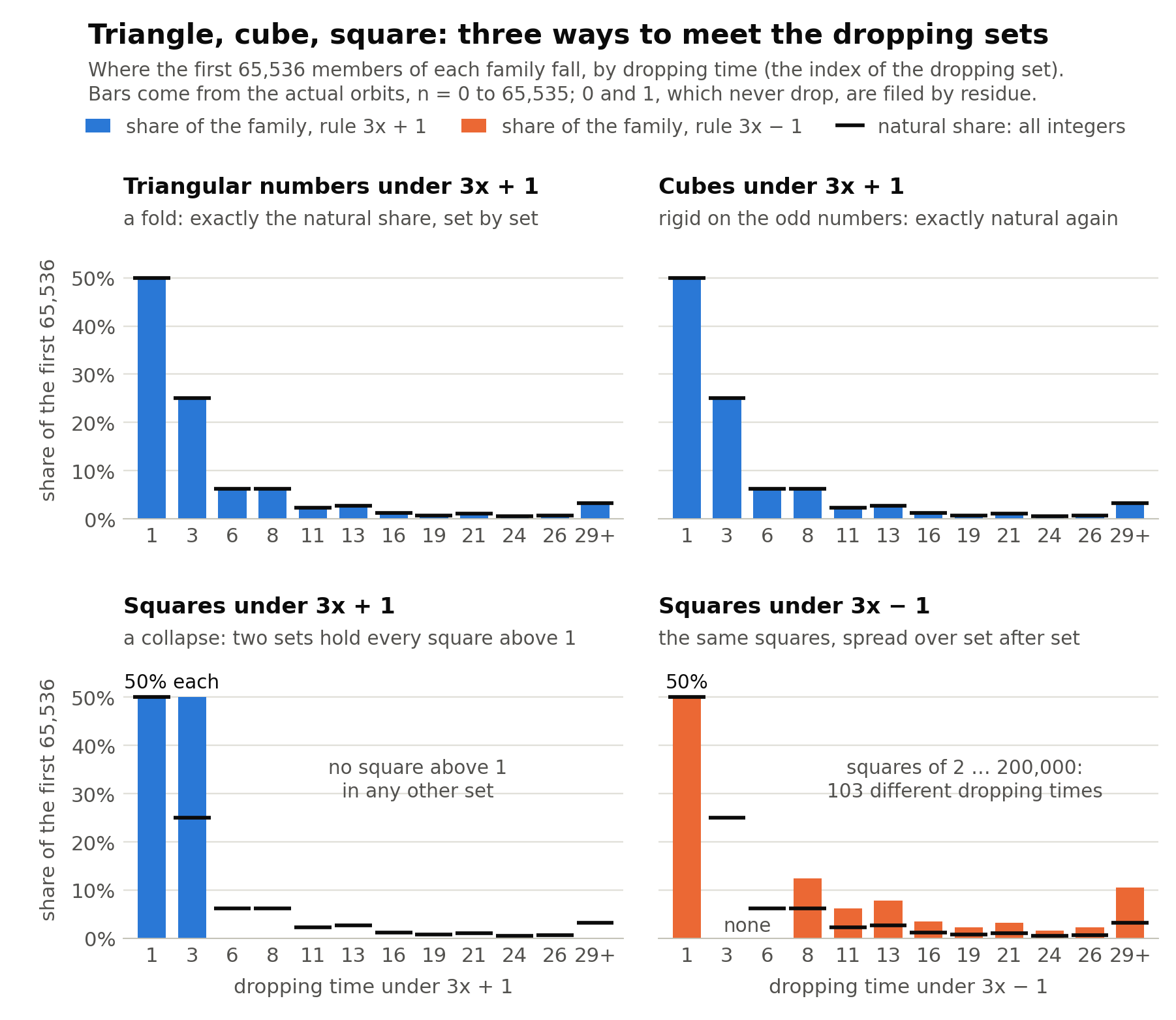
Computed: the squares of show 103 different dropping times under , and exactly two under . (The sums of the first cubes are the squares , and behave the same way.) This is the only statement about figurate numbers here that tells from , and it does so with one bit. An odd square is and never ; under the class is a single dropping set, and under it is the class that is. A statement about cannot bear on the conjecture.
Sum of cubes: a map that can be solved completely
Nicomachus: . Liouville stretched it over the divisors of any : , where counts divisors, and at both sides are : the inner sum sends 36 to itself. So iterate . It is multiplicative with , so goes to , and on:
Theorem (the divisor map , completely solved; proved). Every orbit of ends at one of the fixed points , , , or in the 2-cycle . Outside the ten numbers , every has .
The fixed points are known (OEIS A097989); the full dynamics takes a few lines. Why 36: for any two distinct primes, , where counts the ways to write a number as an ordered product of factors and . So for the sum of the first cubes is a fixed point of exactly when is a product of two distinct primes: (OEIS A164977), giving (proved; elementary; not found in a short OEIS and web search; no novelty claimed). The shape carries the cube identity for every pair of primes. That the primes are 2 and 3 is the accident .
is a pleasant toy and shares none of what makes Collatz hard: it forgets the primes of , keeps only their exponents, and outside ten numbers only counts down.
On the Collatz side of this thread, among the dropping-word counts (how many parity words with odd steps end at their first drop: OEIS A100982, the letters of The Dropping Dictionary), the number 36 does nothing. What governs them is the continued fraction of , and the strongest statement is three weeks older than the run: Winkler's preprint (arXiv:2609.22303, 2026) squeezes between two cycle-lemma binomials and shows that it meets a bound exactly when is the denominator of a one-sided best approximation of , where its value is a rational Catalan number. His Proposition 9 and Bizley's 1954 formula give closed forms at multiples of convergent denominators too, for instance and (proved given Bizley, and verified; the values are terms of A100982, and whether the closed forms are new is unknown). Thirty-six is on that list because and 12 is a convergent denominator, not because . All of it is identical for .
Eight solutions: eight ways to split the point (2, 2)
Euler's is a number exactly when is a power of 2, times a power of 3, times distinct primes of the form larger than 3 (Pierpont primes). Each ingredient brings a lattice vector: brings , brings , and a Pierpont prime brings its own point . Solving means splitting the point into such parts, and the number of ways has an exact generating function (proved; the standard multiplicative argument). Under the usable primes are , and , at the points , and , and the count is :
| Solutions | Built from | Parts of |
|---|---|---|
| 108 | , no prime | |
| 63, 126 | , and twice that | |
| 57, 76, 114 | , , | |
| 37, 74 | , and twice that |
So has eight solutions exactly because 7, 19 and 37 are all prime. That 36 is the least number with eight (OEIS A007374) is a small-number accident: the count is structural, the word "least" is not.
The same lattice point measures a construction. Gleason showed in 1988 that a regular -gon can be drawn with straightedge, compass and an angle trisector exactly when has the form . The point then counts the steps (proved here from Gleason's theorem and classical Kummer theory; whether his paper already states it was not checked): takes exactly square roots and trisections, and no fewer trisections will do. So the eight polygons with each need one square root and two trisections. The decagon sits at : one square root and no trisection, which is the statement .
The Collatz side is a null, and a replicated one (computed). The totient height (how many steps takes to reach 1) shows no dependence on dropping times beyond and the size of , on the odd from to and again, with a placebo test, on the disjoint range up to ; nor do the totient fibres (the sharing one ) for totient values up to . The solution counts show no relation to the counts and no feature along the line . One elementary by-product, identical for : the number of integers whose first value below themselves is a given is finite, and is exactly 1 whenever 3 divides (proved; a multiple of 3 has no odd predecessor). Its average is the 1.69 of The Dropping Dictionary.
cos 36°: the folded pentagon
The fourth fact has a page of its own, The Folded Pentagon. Sort the five residues modulo 5 into three groups, and mass spread evenly within each group moves under the Collatz map exactly as a random walk moves on a pentagon folded along a mirror, so the memory of a starting residue fades by a factor per step (proved). It is special to 5, the only modulus prime to 6 at which every eigenvalue of the residue chain, the matrix of Matthews and Watts, is real (proved). The reason is . The number 36 does not enter, and the same holds for .
What 36 is, and is not
- Genuine, with a mechanism. The largest triangular number built from 2s and 3s (the pair and the cycle through ). A fixed point of (the shape ; that it is the largest is an accident of ). An eightfold point of the totient (7, 19 and 37 are prime; that it is the first is a small-number accident). And the only sum of the first cubes beyond 1 that is triangular (Ljunggren 1946: the only triangular numbers with a triangular square are 0, 1 and 6). Only the first of these touches Collatz, and it reads the same for .
- Not 36 but its neighbours. The pentagon is . On the companion page is one of three primes (31, 37, 41) with unexplained extra eigenvalues, and nothing found ties it to 36.
- Numerology, listed so that nobody has to find it twice. The named intervals as a law for cycles. as "an odd Collatz step" (true at only). "Every dropping word with two or more odd steps passes through the cell " (true, and forced only because ).
Where this lives in the repo
- Research note: Thirty-Six, the synthesis of the five threads
- Threads, each with its proofs, tables and a closing skeptic pass, under
scripts/thirty_six/:harmonic_cycles(the pair 8, 9),figurate_2adic(fold, collapse, rigid),totient_lattice(eight solutions),nicomachus_paths(the map , dropping-word counts),golden_kernel(the pentagon) - This page's figures, and a script that recomputes the worked numbers printed here (the statistical nulls and the larger verifications stay with the threads):
scripts/thirty_six/site_figures/fig_thirty_six_lattice.py,fig_thirty_six_figurate.py,check_thirty_six_page.py - Companion pages: The Folded Pentagon, The Dropping Dictionary, Definitions